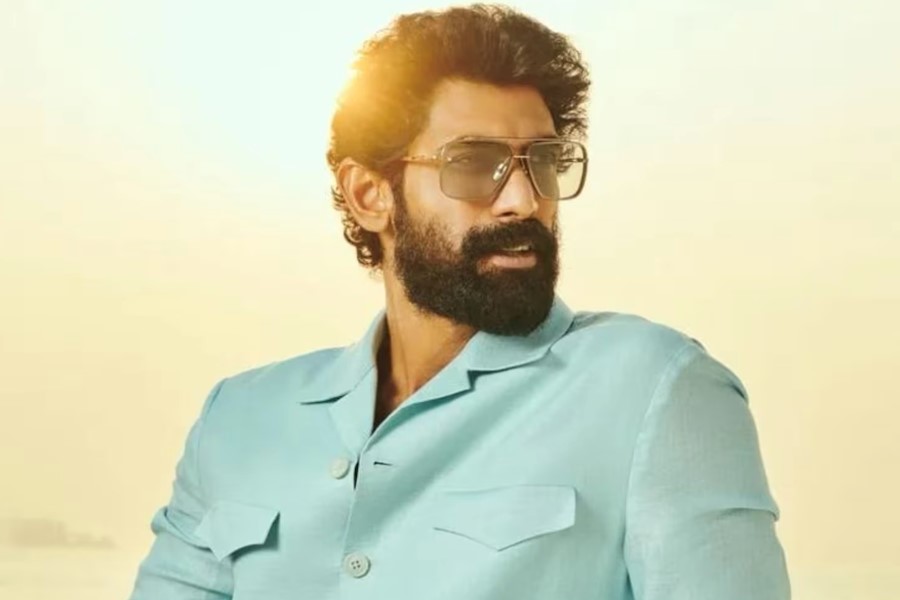
Explaining his perspective, Rana said, “I think ma'am uh storytelling comes in all forms sorry my Hindi is not fluent I can understand but I can't reply back with your fluency problem so uh see I think you'll we always consume stories whether it's from someone telling us a story someone watching it on TV but the big screen has always been the largest format that we always consume and Many times many formats change but the big screen hasn't changed for 100 years which means it's still that most deepest impact that it will have. In fact before the session started we were discussing with Subaraji something that we uh spoke about in 2020 when the first advent of all these short series verticals and all were coming. We said what's going to happen to the big screen and what is the difference between cinema like this and or content like this and cinema like that. So we like a comparison to food where we said short content is like chips and coke. Uh you can there'll be some time in your life you like only chips and coke but after that you need to come back home and eat a full meal or go to a restaurant and enjoy it. So I think all of these will exist. Uh I I'm actually a fan of more and more formats coming the fact that we can become more lit as audience better storytellers deeper thinkers. I think that's what stories do.”
The chips-and-Coke comparison neatly captures the difference between quick digital consumption and the immersive experience of watching a film in a theatre. Short videos and vertical series are designed for immediate engagement, often fitting into the small gaps in an audience's day. Cinema, meanwhile, offers a different kind of involvement, allowing viewers to spend extended time with characters, emotions and an unfolding narrative. Rana's argument is not that one format must defeat another, but that each can serve a different purpose. Just as people enjoy a quick snack as well as a full meal, audiences can embrace bite-sized entertainment while continuing to value stories that demand their time and attention. His support for the emergence of new formats also reflects the possibilities they offer creators and viewers, from experimenting with storytelling techniques to discovering fresh ways of engaging with narratives.
Rana also pointed to the enormous potential of India's audience when asked about the impact of Baahubali, the blockbuster franchise that became a major theatrical phenomenon. Reflecting on what cinema can achieve when viewers come together, he said, “that India is a very big country and if we decide to make watch a film together as an audience we're the biggest in the world so that's I think the biggest limit we can bring people back to the cinemas fully”. His observation places the focus on the collective power of moviegoing. A theatrical release can become more than an individual viewing experience when people across regions and communities participate in the same cultural moment. The success of a film such as Baahubali also illustrates the scale of opportunity that Indian cinema can tap into when a story connects with a wide audience. For Rana, bringing people back to theatres is ultimately about recognising the size and enthusiasm of that audience.
The actor's comments on the next season of Rana Naidu further underline his belief that performers today have more opportunities than ever before. Discussing the show's future, he said, “so I think uh that Netflix will tell you more more than I should but I think there's so many formats today for an actor. You can be on a big screen. You can be on a long format series. You can be in a really short series. So I think it's just exciting both as an as an actor and as audience that you get to consume stories in such different ways. on a much larger note of that.” While leaving further announcements to Netflix, Rana highlighted how the entertainment landscape now allows actors to move between theatrical films, long-form streaming series and shorter digital projects. These formats can offer different creative experiences, and their coexistence creates more avenues for talent to reach audiences. Rather than treating the shift as a threat, Rana sees it as an exciting period for both storytellers and viewers.
At the heart of Rana Daggubati's argument is the idea that storytelling is bigger than any single screen or platform. Vertical videos, short series, streaming shows and theatrical films can all find their audiences, provided they offer something people want to experience. The real question is not whether newer formats will replace cinema, but how each format can develop its own identity while contributing to a richer entertainment landscape. The theatrical experience continues to offer scale, immersion and the shared excitement of watching a story unfold alongside an audience. At the same time, digital formats make storytelling more accessible and create room for experimentation. As Rana suggests, the future need not be a competition between formats. It can be a world in which audiences have more choices, creators have more ways to tell stories, and cinema continues to bring people together on the biggest screen of all.
News Helpline is a Brand in the world of daily Bollywood Content. We are a team of Innovative, Hard working and Creative people working in media since last 15 years. We were the first to sense the changing phase of News Industry with the progress of IT industry. Hence in the year 2008 we came up with a first of its kind Bollywood News Application, a website where we uploaded Bollywood news on daily basis and our client could download this news from anywhere in the world on the same day of the event. Then with the passage of time we improved and evolved. The result is today our client in any area of the world receives their Bollywood news (HD quality) within 2-3 hrs. post event. The value of News is very Time dependent and we at News Helpline deliver the News before thay become rumors.
This website uses cookies.


